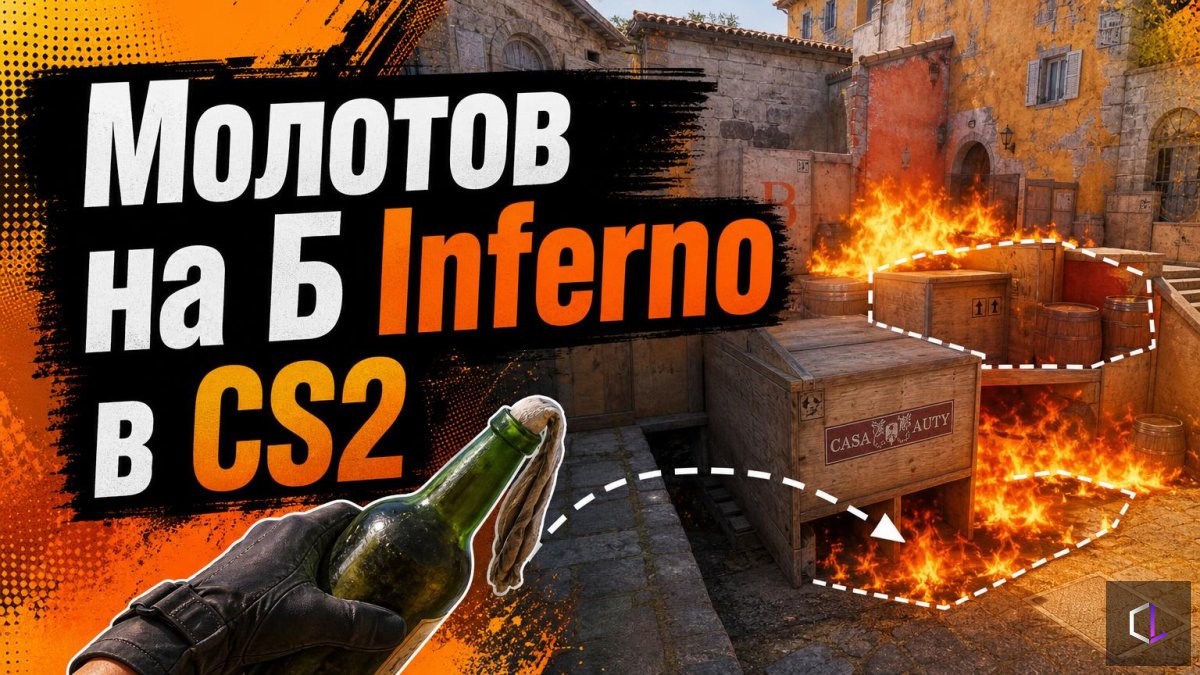
From the ESL Pro League Season 24 final, where Vitality beat MOUZ 3:0, the community took away not a frag or a clutch, but a single grenade. The molotov with which Vitality's players shut down a spot on B began to be analyzed as a working technique for Inferno. The advice from this breakdown sounds almost mundane: if you don't have a full B execute and need to break up a situation based on information right in the moment, throw a molotov that burns both the top and the bottom behind the first and second boxes.
Behind this phrase stands a clear idea: one grenade can have two different tasks, and you shouldn't confuse them when choosing a throw.
Two tasks, one grenade
An execute (a set of grenades a team throws in advance to take a site) is built around a plan. It includes smokes, flashes, and molotovs, and each grenade covers its own angle or screens an entrance. It's an investment: five people have spent money and time on a coordinated chain.
A reactive molotov works differently. It's needed not for a plan but for a response to a signal: information has appeared that the opponent is already on the site, and you need to knock them off their position or at least disrupt their timing. Here, what matters more than precision for one specific angle is the area of effect that covers several likely spots at once.
The recommendation from the breakdown falls into the second category. A single throw that covers both the upper and the lower part of the space behind the boxes saves you from choosing blindly between two options.
Why behind the boxes
The boxes on B site provide cover and block vision, which is why opponents like to linger right behind them, especially when playing for time or waiting for a teammate. The trouble is that "behind the box" is not a single spot: a person can stand higher or lower along the line of cover. If the molotov covers only one of the spots, the opponent simply shifts a step and waits out the fire where it's empty.
A throw that catches both levels at once breaks this game. The fire doesn't kill, but it forces a choice: stand and take damage, step out into the open, or retreat. Any of the three options opens a window for your team.
The price of versatility
The technique has a downside. A grenade that covers a lot is usually weaker than a specialized one: it doesn't guarantee that the fire will land exactly where a particular player is standing, and it doesn't screen an entrance as reliably as a well-practiced lineup for a single angle. That's why such a molotov doesn't replace an execute but complements it. It's needed when the plan has fallen apart, there's no execute, or there's no time for one.
There's also the question of economy: a molotov costs money, and spending it "just in case" in a round where every grenade counts is not worth it. The decision to throw is always an answer to two questions: do I have enough information, and is this gain in time worth the lost grenade.
How to build your own version
You'll have to practice the specific throw points and positions yourself: in-game it takes a few minutes on a practice map or in a private match with bots. A useful order looks like this:
- find a throw spot from which you can see both levels behind the boxes that interest you;
- check that the fire really reaches the top and the bottom and doesn't die out on the step;
- repeat the throw at least ten times in a row so that it becomes a reflex rather than a lineup you recall in five seconds;
- note in which rounds this molotov was wasted and in which it decided the outcome of the contact.
The last point usually reveals the main thing: a versatile grenade is valuable not