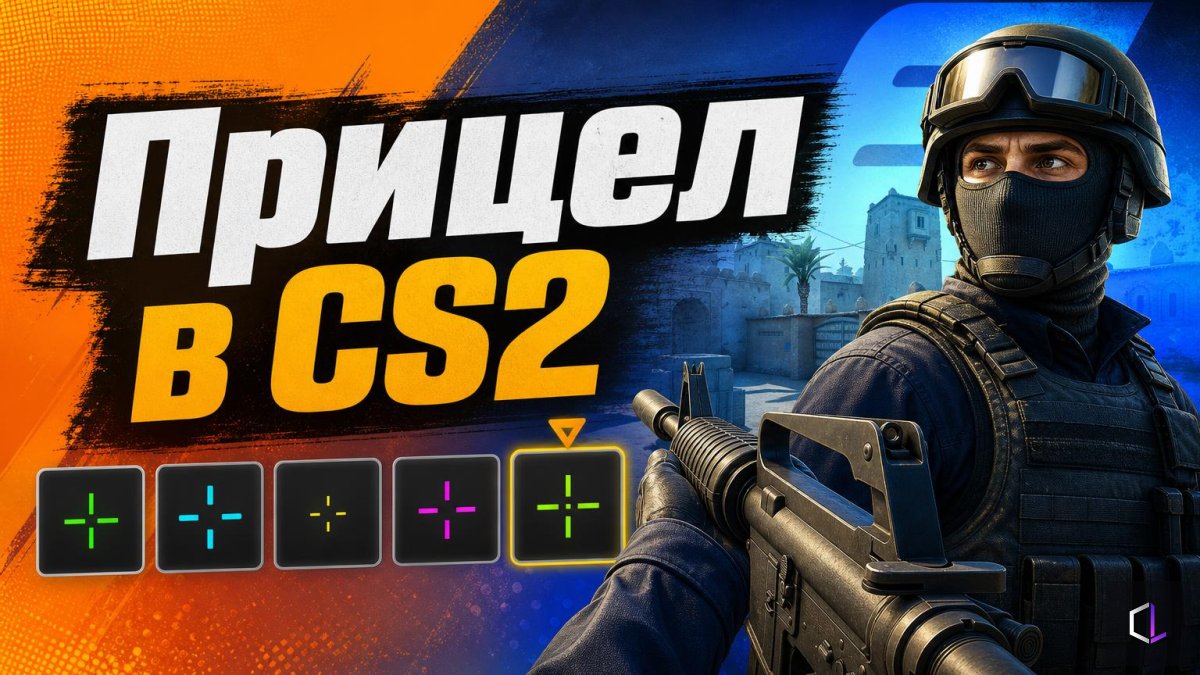
Anyone who has ever changed their crosshair in CS2 in the middle of an evening knows the feeling: five minutes ago a thin dot seemed perfect, and on the next map it got lost against the background of a wall. Recently the community discussed an idea from Reddit: letting players save several crosshairs and switch between them, as is done in some other games. Valve has not announced such an update; for now it is just a suggestion. But it highlights a question worth examining: how many crosshairs does a player need, and is there any need to switch between them at all?
What a crosshair is made of
In CS2 settings, a crosshair is assembled from several parameters: style (static stays unchanged, dynamic expands when running and shooting), color, line length and thickness, the gap in the center, an outline, and an optional center dot. A ready-made setup can be copied as a code and passed to another player, so professionals' crosshairs are easy to reproduce for yourself.
It is easy to fool yourself here. The shape of the crosshair determines how comfortable it is for the eye to catch the center of the screen against different backgrounds, and that is all. Where that center is pointing at the moment an opponent appears depends on a different skill: placing the crosshair at head level (in the community it is called crosshair placement). The best crosshair in the world won't help if at the start of the round it is pointing at the floor.
What makes the idea of quick switching appealing
The arguments in its favor are clear. On light maps like Dust2 one color reads better, on dark and busy ones another. Some people like a thin crosshair for long-range duels and a more noticeable one for short ones. When there are no saved options, you have to re-enter the parameters by hand or keep codes in notes, and that is annoying.
One crosshair and an honest way to test it
My position: switching between crosshairs during play does more harm than good. There are three reasons.
- Habit is built on repetition. The eye and hand get used to one image of the center. Every change sends adaptation back to the beginning, even if only slightly.
- The crosshair becomes a convenient excuse. A streak of misses is easily blamed on an "uncomfortable crosshair", although the causes are usually positioning, recoil control, sensitivity, or fatigue. As long as you keep changing the crosshair, the real mistake stays untouched.
- Choosing "by mood" yields no data. You can't tell what exactly worked if color, thickness, and gap all changed in one evening.
Saved crosshairs are useful in a different role: as an archive of experiments. This order works:
1. Change one parameter at a time: color or thickness, but not everything at once.
2. Test on the same exercise and the same map so that conditions are comparable.
3. Give the new variant several days, not one match, because first impressions are deceptive.
4. Keep a crosshair only if you lose the center of the screen less often with it, not just because it looks nicer.
It is reasonable to keep one variant in reserve: a contrasting one, for a map where your main crosshair really does blend into the background. An outline and a bright color usually solve this problem without changing the shape, so a spare crosshair is rarely needed. If you reach for it often, first check whether the cause lies in the lighting around your monitor or the brightness of the game itself.