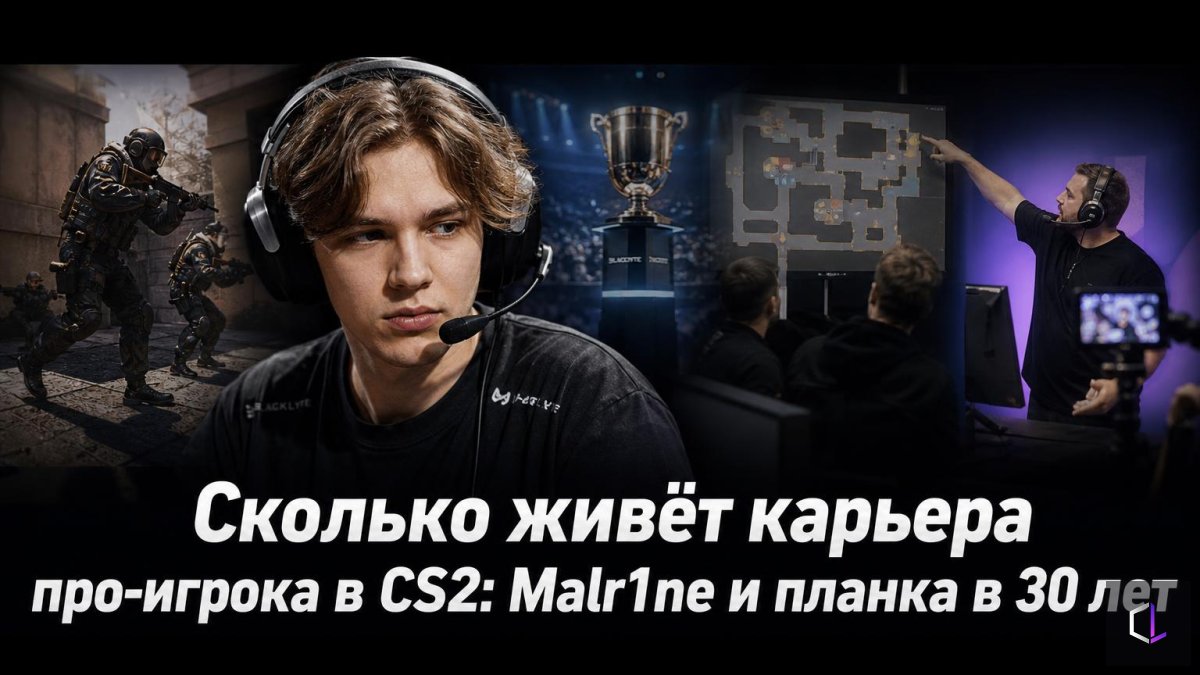
The player Malr1ne is 22 years old right now, and he has stated that he intends to stay a professional until 30. After his career, he sees himself as a coach or a streamer. The statement in itself is not a sensation: the man simply named a deadline. But it is precisely the deadline that makes him interesting, because in esports it is customary to assume that a pro player's story ends much earlier.
Where the Myth of "Cyber-Retirement" Came From
The notion of a short esports career rests on reaction speed. It is believed that by 25 speed drops, and those who are younger and faster take their place. There is some truth in this picture: mechanics really do demand honed reflexes and do not forgive wear and tear.
But in CS2, victory is made up of more than just aim. A player has to know timings, read the opponent's economy, hold a position, and understand when it is time for the team to change tempo. This knowledge accumulates over years and does not age as quickly as reaction speed. That is why in a team game where roles and decisions matter, age often works in a player's favor: a veteran may lose duels but win by choosing the right moment.
Of course, the advantage does not come free. Experience is valuable only as long as the body allows you to apply it. The wrist, back, eyesight, and sleep all require care, and the routine of a person at 28 and at 18 are two different routines.
What Stands Behind the "Until 30" Figure
The age-30 mark is not a forecast but a reference point, and it is useful to understand what it takes to reach it.
- Health. A pro player spends hours a day at a computer, and strain on the wrist or back can end a career sooner than any decline in form.
- Motivation. Training toward the same goal for eight years in a row is a psychological task. Burnout in esports is as common a reason for leaving as age.
- A place in the lineup. You can play for a long time only if teams keep picking you. For that, maintaining your level is not enough: you need to be useful to the team in some other way, for example through leadership, communication, or versatility.
- Adaptation. The game changes with patches, and a player who does not adapt falls out of the meta faster than he ages.
In other words, the age-30 mark is not a question of age as such. It is a question of how well a person knows how to look after himself as a professional over the long haul.
The Second Act: Coach or Streamer
The second half of the statement is also interesting. Coach and streamer are the two most typical routes after a playing career, and they require different skills.
A coach sells an understanding of the game and the ability to explain. This is work with people, with analysis, with planning, and it is here that experience of making decisions under pressure comes in handy. A streamer sells personality and the ability to hold an audience: skill at the game is needed, but charisma and consistency are needed no less.
It is telling that the player is thinking about this at 22, while at his peak. Many begin to think about "after" only when their contract has not been renewed. Planning early does not signal weakness: it is precisely what reduces the risk that the exit will be forced and abrupt.
What to Know About Statements of This Kind
Any "I'll play until 30" is worth reading with a caveat: circumstances change, rosters fall apart, patches break familiar roles. It is not a promise but a declaration of intent. Its value lies elsewhere: it shows how a professional looks at his own horizon. Not as a chance event that will simply happen on its own, but as a project with a deadline, stages, and a backup plan.
For viewers and for the parents of future players, a simple idea follows from this: a career in esports is neither a sprint nor a lottery, but a craft with understandable risks. The one who wins in it is not the one who starts fastest of all, but the one who chooses a routine that can be sustained for years.