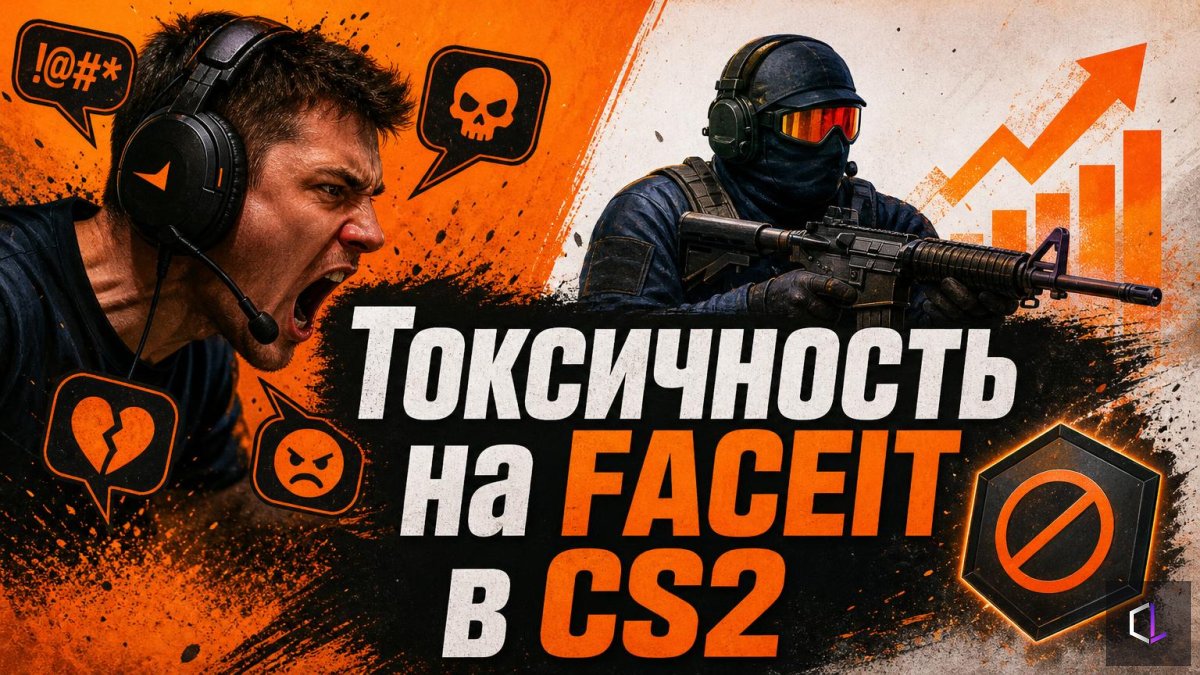
FACEIT published statistics that surprised many people: the number of bans for toxic behavior grows along with ELO. Intuition suggests the opposite — low levels are played by "hotheaded newcomers," while the top is filled with composed professionals. The numbers say otherwise. Let's try to understand why this happens by comparing two worlds: the lower and upper tiers of the rating.
Low ELO: noise, but no stakes
At low levels there are plenty of mistakes, but expectations are lower too. Missing a smoke, a pointless death on entry, a dropped defuse — all of this is perceived as a normal part of the game. Players rarely build serious plans around a round, so the disappointment is short: they swear and move on.
There is also a second factor: teammates change constantly. The person you argued with will vanish from your life after the map. Rudeness has almost no social cost.
High ELO: every round costs more
The higher the rating, the more a player has invested: hundreds of hours, habits, self-esteem. For such a person, a round lost because of someone else's mistake is not a trifle but a blow to what they consider their level. Expectations of the team grow along with the rating, while tolerance for mistakes falls.
Add to this the density: at high ELO a mistake is visible immediately and is often unambiguous. If the enemy was given a peek that is always held, the culprit is obvious, and the complaint sounds specific. A specific complaint easily turns into an insult.
There is one more reason that should be mentioned honestly: at high levels the platform's attention is higher as well. Players with a high rating are watched more often, reported more often, and the system has more material to react to. Part of the growth in bans may be related not only to behavior but also to how monitoring is set up. This cannot be deduced from a single publication, so the conclusion "everyone at the top is more toxic" would be hasty.
What they have in common and where they differ
What they share is the mechanism. Toxicity almost always comes from the same thing: a mistake + a feeling that it shouldn't have happened + no outlet for the tension. What differs is the price. At a low level, a meltdown is just an unpleasant evening. At a high level, it directly breaks team play: a player on tilt (a state in which emotions interfere with decision-making) shoots worse, hears information worse, and reads the situation worse.
The result is a paradox: someone who swears in order to "correct" a teammate most often worsens their own result and the result of the whole team.
What it looks like in practice
An attentive player at high ELO usually does three things:
- speaks about a mistake briefly and without judging the person: "peek is open, let's close it" instead of "what are you doing";
- does not discuss the previous round during the next one: while the buy phase is going on, attention should be on the economy and tactics;
- breaks the chain themselves — if they feel they are losing control, they stay silent for one round instead of responding to provocation.
A mute (turning off one player's chat) is also a tool, not a defeat. It is always useful to doubt that someone else's remark helps win the round.
Statistics as a mirror
The growth of bans with ELO is not a reason to consider the upper part of the rating a gathering of troublemakers. Rather, it is a reminder: shooting and tactical skills grow faster than the skill of keeping yourself together under pressure. The rating rises while emotional resilience stays at the same level, and the gap between them turns into bans. Those who train both sides gain an advantage where opponents lose rounds for no reason.