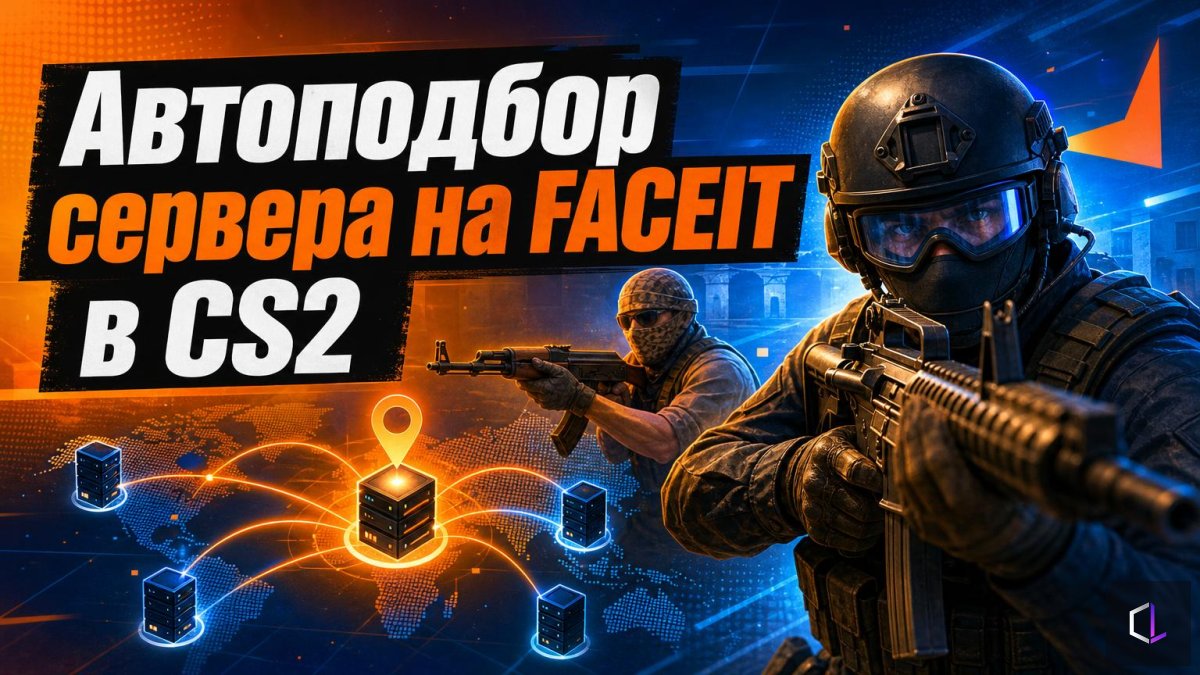
FACEIT will add automatic server selection: the platform will determine on its own where a player and their team will be most comfortable playing. The new feature arrives with the launch of Season 10, which starts on December 9, 2026. According to the description, the system accounts not only for ping but also for packet loss. For those who play CS2 on FACEIT, this is a reason to rethink their own habits right now, before the season starts.
What Exactly the System Evaluates
Ping is the time it takes for a signal to reach the server and come back, measured in milliseconds. Packet loss is the share of data that disappeared along the way and had to be resent. Players usually look only at the first figure, although the second hits gameplay harder: a steady 40 ms with rare losses feels better than an "average of 25 ms" with jerks.
Auto selection should account for both parameters at once and choose the server where the picture is best overall for all ten participants in the match. The side effect is obvious: if you used to pick a data center manually or put up with a random one, now the decision is made by an algorithm.
What to Do Before December 9
1. Measure the real picture. Enable the `cl_showfps 1` command in the CS2 console and turn on network information display in the game settings. Record your ping and losses over several evenings, during the hours when you usually play. A single measurement in the morning isn't enough: evening load on your ISP changes everything.
2. Check your connection. Play over a cable, not Wi-Fi. Close torrents, cloud syncs, and updates on all devices on the network. If losses appear only when someone at home is watching video, the problem is in the router or the plan, and no auto selection will fix it.
3. Record a baseline before the season. Save your numbers and compare after launch. That way you'll understand whether the new system actually helped you, rather than judging by feel.
4. Revisit your peek timings. If your ping changes by 15–20 ms after a server switch, duels at corners will behave differently. A player with higher ping sees the opponent later than the opponent sees them, and vice versa. A few practice games after the switch are worth spending on re-learning when it's safe to peek a corner and when it's better to wait.
5. Update your expectations of matchmaking. Auto selection may narrow the pool of opponents geographically: the harder the system optimizes ping, the more often matches will be assembled from players of the same region. For some this is a plus — familiar opponents and an understandable style — for others a minus — less variety. Watch how match quality changes in the first weeks of the season, and don't draw conclusions from a couple of games.
Why Stability Matters More Than the Minimum
Low ping by itself doesn't make a player stronger, but unstable ping makes them weaker. Aiming, spraying, and corner peeks are built on muscle memory, and it relies on the game's predictable response. When packets are lost, the response to a keypress arrives with varying delay, and the hand constantly has to relearn. That is exactly why professionals at tournaments play on local servers with dedicated lines rather than on public ones: what matters to them is not a millisecond record but identical conditions in every round.
An amateur isn't afforded such a luxury, but something else is within reach: making your own conditions as even as possible. A cable instead of Wi-Fi, a clean network during the match, and knowing your own numbers give more than any in-game setting. Server auto selection takes one item off a player's list, but the rest remain theirs.
If after the season launches you notice that duels feel different, don't rush to blame the update. First check your recorded measurements: it often turns out that what changed was not the server but your ISP's evening load.