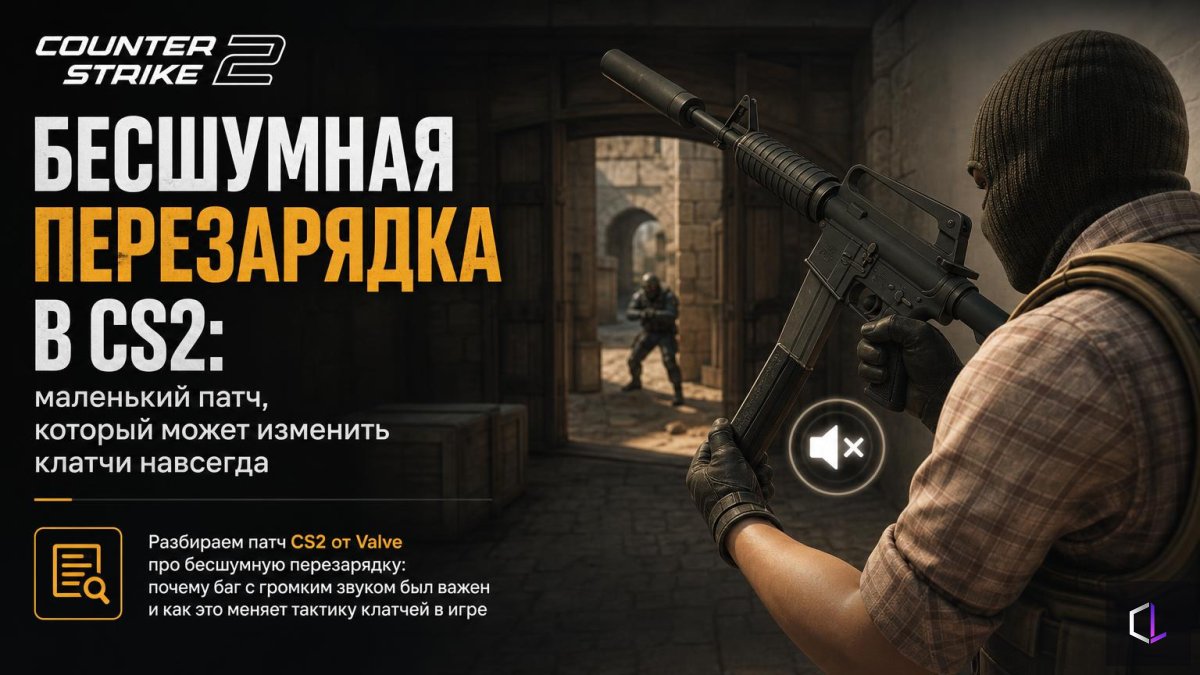
Silent Reload in CS2: A Small Patch That Could Change Clutches Forever
An update that's easy to overlook — and shouldn't be
Valve has released another CS2 update, and at first glance the list of changes looks routine: fixed geometry on Rush, added a server option to disable clan tags, tweaked some cosmetics in the lobby. But one item in the "Gameplay" section deserves a separate discussion — Valve fixed a bug that caused the game to sometimes play the sound of a regular, loud reload even when the player attempted a silent reload.
Sounds like a minor thing. In reality, this is a mechanic that directly affects how clutches play out — 1-vs-several situations where survival depends on information: whether the opponent can hear you or not.
Why silent reload isn't just a "feature"
In CS2, a player has the ability to reload their weapon quietly by releasing the button before the animation reaches its final, "loud" part. This lets you top up your magazine without giving away your position to the opponent. The problem was that the mechanic worked unreliably: a player would do everything correctly, but the engine would still play the full reload sound — meaning the opponent received information that, by the game's logic, shouldn't have been available.
For a casual match, this is an annoying detail. For a tournament clutch, it's a factor that can cost you the round, the map, and the match. That's exactly why this fix is being discussed among players and analysts far more actively than the geometry changes on Rush: it directly changes the risk calculation in the decisive seconds of a round.
How this changes tactics
Before the fix, experienced players accounted for the instability: even knowing the timing of a silent reload, they had to play it safe and avoid reloading during a clutch, so as not to give themselves away with a random sound. This limited the variety of decisions — often a player would prefer to stay with a partially empty magazine rather than take the risk.
Now that the mechanic works predictably, a clutching player gets more legitimate options:
- reloading between firefights without fear of revealing their position;
- planning a 1vX play in advance, factoring reload timing into the plan itself rather than treating it as an emergency risk;
- playing off sound with more confidence overall — an opponent who hears silence no longer gets false information suggesting a reload didn't happen.
Essentially, Valve removed an element of randomness from a mechanic that should have been deterministic from the very start. For competitive play, this matters more than it seems: the fewer unpredictable bugs there are in the game, the more fairly the win goes to the player who calculates timings better, rather than the one who got lucky with the engine's randomness.
What players and parents should do with this
For teenagers seriously into CS2, patches like this aren't a reason to panic or think "they broke everything again" — they're a signal that the game's mechanics are constantly being refined, and a successful player is one who quickly adapts their habits to them. Understanding when and how to reload silently isn't about reflexes — it's about cool-headed calculation under stress, and that's exactly what separates a player with good aim mechanics from a player who actually wins rounds alone against multiple opponents.