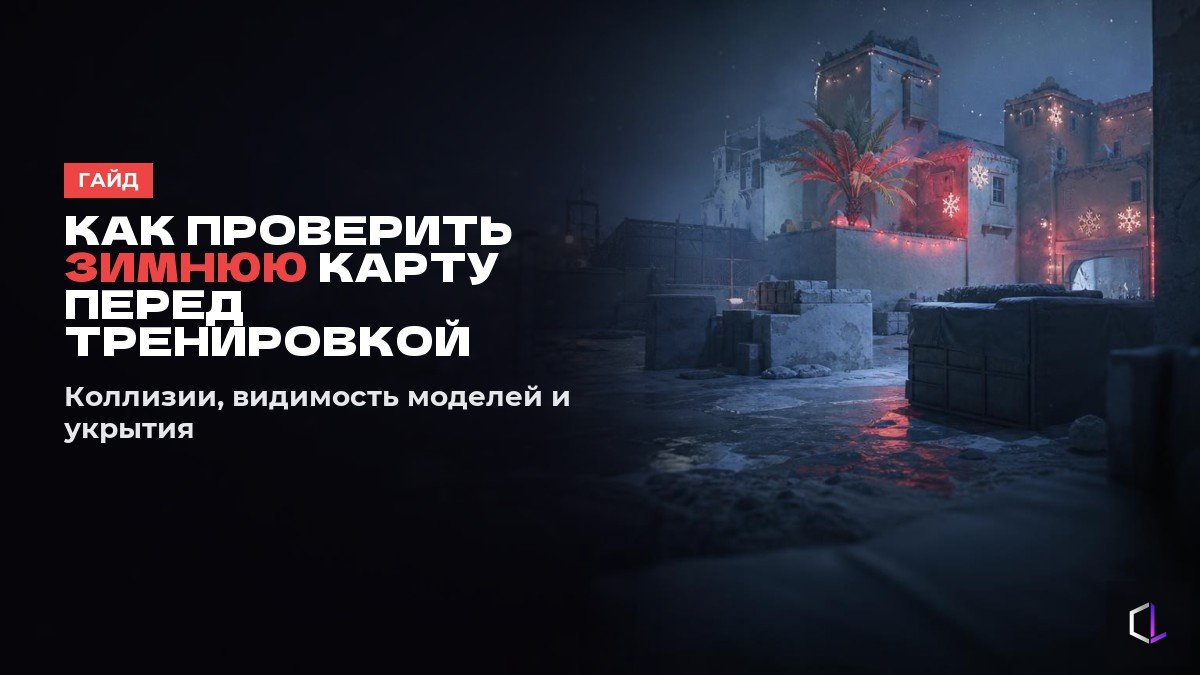
Snow on Dust2 looks like a reason to change the familiar surroundings. But before moving a training session to a map like this, it is worth checking how closely it matches the original. A familiar location with a different look lets a player see how confidently they can navigate without their usual visual cues.
A seasonal version may be suitable for a friendly match, but its usefulness for precise positional practice depends on the specific implementation. You can check this in one short visit.
First, Define the Task
For casual play, it is enough that the map loads and the group likes it. For competitive match preparation, the requirements are stricter: cover placement, surface heights, and available routes must match the map you will be playing on.
Before checking, choose one task:
- Crosshair placement: moving out from behind cover with your crosshair at the opponent’s expected head height.
- Enemy detection: spotting a player model against different backgrounds.
- Movement: following a familiar route without unnecessary collisions or adjustments.
- Team communication: calling out an opponent’s location quickly and unambiguously.
Do not try to assess everything at once. If the task is to check model detection, the score of a random match will tell you little: shooting, the lineup of players, and team decisions all affect it.
Four Checks Before a Full Session
1. Walk a familiar route without opponents. Choose a path past several pieces of cover and repeat it on the standard and seasonal versions. Pay attention to places where you have to turn, jump, or go around an obstacle differently. A visible snowdrift does not necessarily change movement: what matters is collision—the invisible boundary of an object that the character bumps into.
2. Compare several familiar angles. With a partner, take the same positions on both versions of the map. Check how much of the model is visible from behind a box or wall. If the cover works differently, that position cannot be considered an exact substitute for its competitive counterpart: the habit of peeking out a certain distance may not apply.
3. Check model readability. Ask your partner to stand against a light background, in shadow, and near decorative objects in turn. Keep the resolution, brightness, and other image settings unchanged. Otherwise, it will be difficult to tell what made the opponent easier or harder to spot.
4. Agree on position callouts. Use the usual names for areas of the map rather than temporary landmarks such as “behind the Christmas tree.” Run a simple check: one participant names a position, and the other points to it with their crosshair. Any discrepancy should be corrected before the game begins.
Decorations Can Become an Attention Test
On a familiar map, a player often reacts not to the position itself, but to a memorized patch, a texture edge, or lighting. A different look helps reveal this dependence. If your crosshair consistently ends up below the required level after the background changes, it is useful to anchor its placement again to the geometry of the passage and the likely head position.
To do this, walk through a small section, stopping before each new angle. First name the opponent’s possible position, then aim your crosshair, and only then move to reveal the view. After the exercise, repeat the same section on the standard map: correct crosshair placement should remain consistent without the help of festive landmarks.