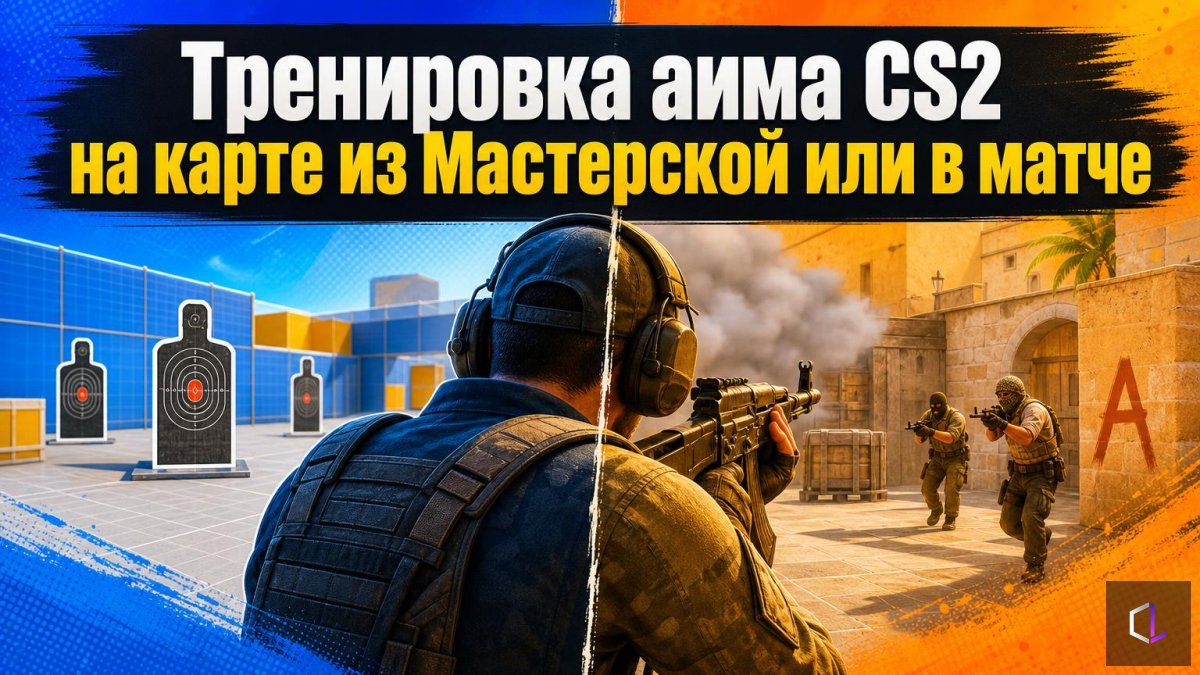
A shooting practice map has been released on the Steam Workshop, and more than 10 thousand players downloaded it within a day. That number points to demand: people need a tool that closes the gap between "I'll shoot some bots as a warmup" and "I'll play a match." The map's feature set is telling: spraying and transferring fire between bots, recoil control hints, adjustable difficulty and enemy behavior, custom drills with statistics, and a range with moving targets.
This map is a convenient occasion to compare two ways of training aim: isolated drills on a practice map and training through matches. Arguing over which is better is pointless: they solve different problems.
What the map offers
The map's main advantage is that it strips away everything unnecessary. In a match you shoot once every few minutes, and between duels you walk around, listen to callouts, and think about the economy. On the map, ten minutes give you more repetitions than several games.
Several strengths follow from this:
- Controlled difficulty. You can make the bots slower and have them stand still, then add movement. You won't get that kind of gradation in a match.
- Measurability. Statistics show whether your accuracy is actually growing or you just feel like it is. Impressions about aim are deceiving: after a good match you think you're making progress, and after a bad one you think you aren't.
- One mechanic at a time. Recoil, fire transfer, and shooting at a moving target are trained separately, and any weakness is immediately visible.
Two basic terms. Spray is shooting with the button held down while compensating for recoil: the crosshair climbs up and to the side following the weapon's pattern, and the player pulls the mouse back. Transfer is a quick switch to a second opponent after killing the first, without a pause to re-aim.
What the map doesn't offer
Isolated training has a ceiling. Bots don't get scared, don't play from cover, and don't change tempo, and you aren't required to keep your crosshair at the right height and in the right spot: on the map, the target simply appears. In a real duel you first have to guess where the opponent will show up and pre-position your crosshair there. This skill is called crosshair placement, and it barely improves in solo drills.
The second trap: on a practice map it's easy to get nice numbers and carry nothing over into the game. Muscle memory gets built, but the decision of "shoot now or fall back" remains untouched.
What a match offers
A match is the opposite picture. Everything missing from the map is here: pressure, incomplete information, choice of position, reaction to a real person. This is where the habit of keeping the crosshair at head level and entering a corner by "strafing" (a short sidestep) instead of running takes shape.
But a match has its own weakness: the feedback is blurry. You lose a duel and can't tell whether recoil, reaction, positioning, or just bad luck was to blame. Without separating the causes, it's hard to train: you repeat everything at once and nothing in particular.
Where the approaches converge
Both methods share a common foundation: repetition with feedback. The map provides clean repetitions and numbers, the match provides real conditions. The best results come from a routine in which each covers the other's weakness:
1. A 10–15 minute warmup on the map before playing. First fire transfer and spray at medium range, then moving targets. The goal is not to set a record but to warm up your hand.
2. One task per week. Not "improve aim," but, for example, "a consistent first bullet during a spray" or "transfer to the second target without a pause." It's visible in the map's statistics.
3. A check in the match using a single criterion. After a game, ask yourself one question about that same task of the week, rather than trying to evaluate the whole game.
4. A weekly comparison of the numbers. If your results on the map are growing but not in matches, the problem is no longer mechanics but crosshair placement and positioning. Then you need to switch to reviewing duels instead of adding hours on the range.
This division is useful because it shows where to spend your time. If your accuracy on the map drops with moving targets, working on mechanics is justified. If everything is fine on the map but in games you keep losing the first duel, range drills won't help: the cause lies in your decisions.
Practice maps don't replace matches, they make them more effective: until your mechanics are measured, you can't tell a problem of the hand from a problem of the head.
The Workshop provides what used to require separate programs, and the main question is no longer the availability of the tool but discipline: one task, a short block, a check in a real game.