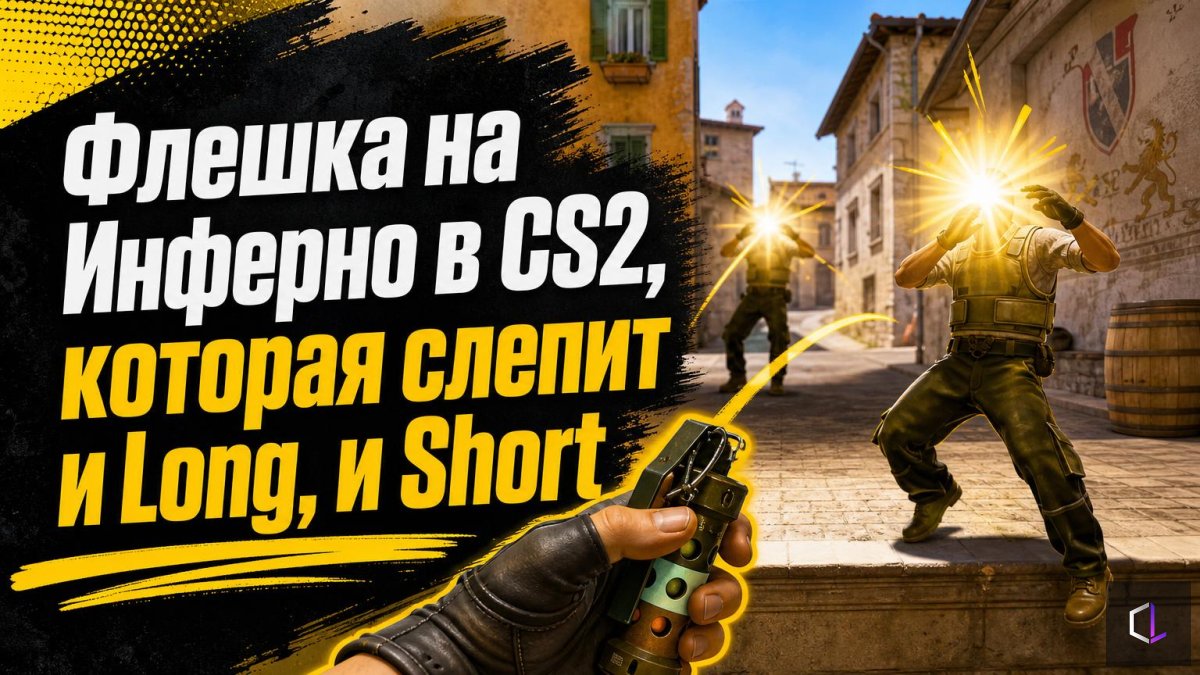
The "best flash" is making the rounds in the CS2 community again — this time for Inferno: a single throw that blinds both the player on Long and the player on Short at once. A similar find is going around for Mirage, where a flash for the B site hits an opponent in an awkward position and doesn't affect your own teammates. The lineups themselves (calculated throw points) can be taken from any collection of nade spots. What's more interesting is something else: how such a universal grenade differs from the familiar edge throws, and when to choose which.
Two Ways to Blind
The classic approach is the edge flash: the grenade flies to the edge of a doorway and detonates in such a way that it blinds one specific opponent while the others keep their sight. Its main advantage is precision. You decide in advance exactly who you're taking out, and you build your teammate's entry around that moment.
The universal flash works differently. It detonates at a point from which two directions are visible at once, and blinds everyone looking that way. You don't pick a target, you cover the space. Such a throw is good where an opponent might be standing in several places and you don't know which.
What They Share and Where They Differ
The two methods have one thing in common: a flash does nothing on its own. It buys a few seconds, and the value of the throw is determined by what the team does with that time. If you blinded the enemy but nobody pushed out, the grenade was wasted.
The differences show up in three parameters:
- Information. A precise flash requires knowing where the opponent is standing. A universal one works blind, so it suits situations when you have no information.
- Risk to teammates. An edge throw is easy to calculate around a specific teammate's entry. A wide flash covers more space, and it's easier to catch an ally at the edge of the zone, so you need an agreement on who goes out and when.
- Predictability. Because of its popularity, a universal lineup quickly becomes known to the opponent too. If the enemy knows that a flash always awaits you at that spot, they can play around it by backing off or answering with a counter-flash.
So the universal flash isn't "better"; it solves a different problem: it insures against uncertainty, whereas the precise one wins where there is no uncertainty.
When to Use Each
A universal flash makes sense on contact and in the late round, when the team is moving onto a position where two defensive setups are possible and there's no time to scout. It also makes life easier for a poorly coordinated group: it demands less synchronization than a series of precise throws.
A precise flash is needed when you've already gained information — heard footsteps, seen utility, caught the timing. In that case an extra blinding effect isn't needed: it's enough to take out one player and thereby preserve your allies' vision.
The practical takeaway for practice is this: learn one lineup of each type for the same position and run them in the same situation. You'll quickly see where the universal flash ruins your own attack because the team itself can't leave the zone, and where the precise flash spends too much time on setup. A single position played in two ways is remembered noticeably better than ten separate throws from a collection.
For those assembling their own set of grenades, it's worth remembering the cost as well: every flash takes up a slot in your inventory. A universal flash that fits many rounds saves a slot. A narrow lineup that works in only one situation more often ends up unused in your bag.