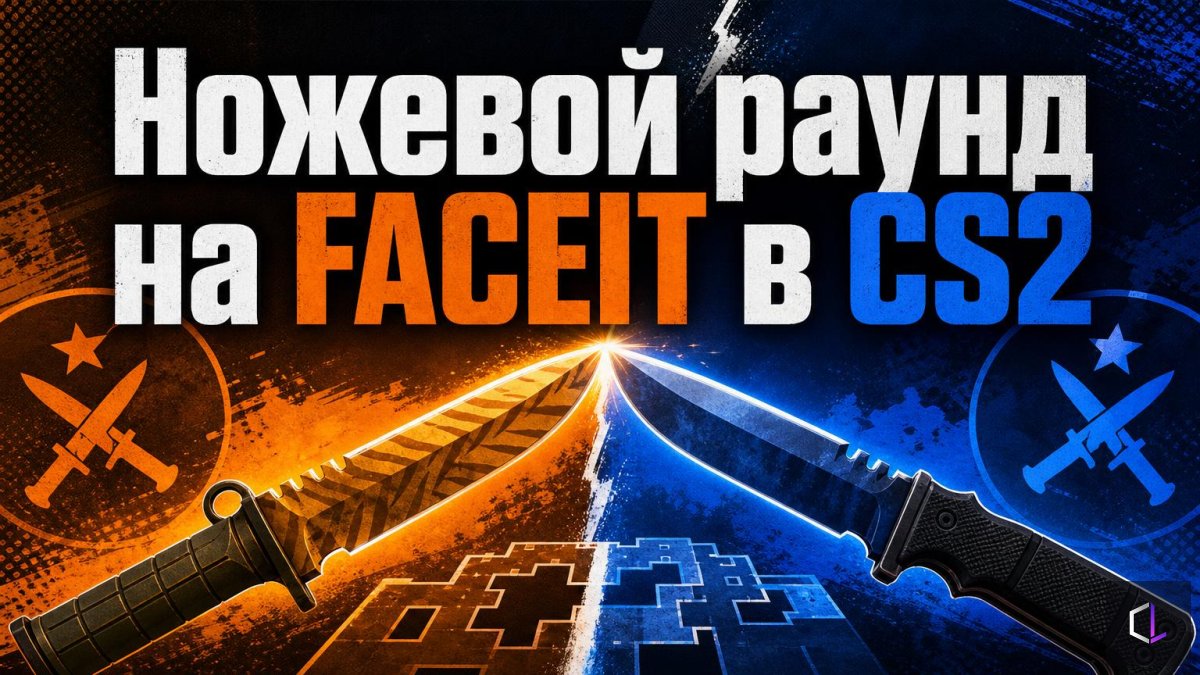
FACEIT has launched a vote: keep the knife round in matches or replace it with random side selection. The platform plans to test the second option next season. No decision has been made yet, but a team that plays ranked matches should prepare for both outcomes now.
What the Knife Round Actually Decides
Before the match starts, once the map is determined, both teams go into a short round with knives only. The winner picks a side: attack (T) or defense (CT). From the outside it looks like a formality. But it determines who plays the first pistol round, that is, the round where everyone has only starting pistols, on which side.
The outcome of the pistol round sets the economy for the next several rounds. The winner gets money for a proper buy, while the loser has to save (play eco, meaning buy almost nothing). That's why the knife round is a small but real lever: it lets a team start on the side where it is stronger.
What Changes With Random Sides
Supporters of abolishing it usually talk about speed and fairness. The match starts faster, and the result of a knife duel, which is almost unrelated to playing with guns, stops influencing the first half of the map. The counterargument is the mirror image: the team loses control over where to start. If a roster has a clear imbalance across maps, a random side turns into a lottery.
A tactical conclusion follows from this: the less a team depends on side selection, the less it matters what gets decided in the vote. As long as a roster is stronger on one side, any format will be its weak spot.
Steps for Next Season
1. Build a side table. For each map in your pool, write down how many rounds you won on T and on CT in recent matches. Mark maps with a noticeable imbalance separately: these are your risky maps.
2. Prepare a pistol round for each side. Decide in advance who takes armor, who takes grenades, who takes the defuse kit (it speeds up defusing on defense), and where each player goes. One basic setup and one backup variant per map and side is enough.
3. Distribute maps in the ban and pick phase by imbalance. If sides become random, ban the maps where your gap between T and CT is the largest. Pick those where the team is equally confident on both sides.
4. Agree on a default side. If knives stay, choosing the side after a win should follow a ready-made list: for each map it's clear in advance what you take, and nobody argues in chat.
5. Rehearse the knife round once. The knife is a separate duel: it gives the highest movement speed, and most importantly, don't be the first to go into open combat. Hold your angle, don't chase a retreating opponent, and don't run in a column through a single passage. The check takes half an hour, and it's useful for a team to win such a round.
6. Warm up for both sides. Before the match, run through both the T-side executes and the CT-side stances. If the side comes up at random, you won't have time to "get into" a disliked role within the first rounds.
7. Vote. It takes a few seconds, and you have your own statistics to understand which option is better for your roster.
The vote also shows a more general point: the platform is ready to reconsider small match rituals if they aren't tied to skill with weapons. Teams that already command both sides and have a polished pistol round will only benefit from such a change: some of their competitors will find themselves on a disliked side with no backup plan.