CS2 statistics include a metric that rarely makes it into reviews, even though it says more about a player's role than K/D does: the number of kills teammates get on blinded targets. By this metric, averaged per 100 rounds, apEX of Vitality is the leader. The paradox is that he himself doesn't look like a star in terms of kills: a significant part of his work turns into other people's frags.
How to Read This Metric
The metric doesn't simply count the number of enemies blinded, but the kills that happened thanks to his flash. The difference is fundamental. A player can "flash" five people in a match and give the team nothing if no one managed to use the window. Or he can blind just one, but in such a way that a teammate goes into a duel where the opponent has no chance to respond.
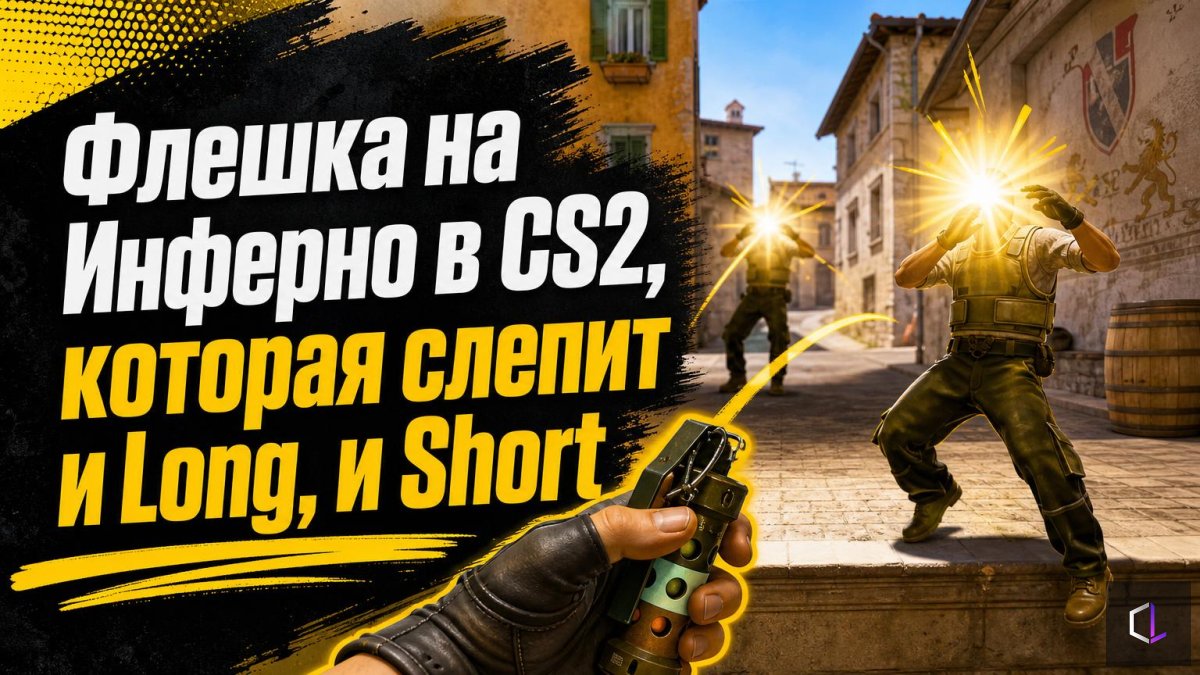
A blinded player can't see the screen for anywhere from 0.5 to several seconds (depending on how directly he was looking at the flash), but the sound remains. He can still hear footsteps and can shoot at sound. That's why a good flash isn't "blind and wait," but "blind and enter at the same instant."
What Makes a Good Flash
Three components, and having just two of them isn't enough:
- Burst location. The grenade should pop in front of the target's face or slightly above head level. If it explodes behind them or far to the side, the player has time to turn away.
- Timing. A flashbang explodes about 1.5 seconds after it's thrown. It needs to be thrown with a margin, so that the flash coincides with the moment your teammate has already started moving.
- Agreement. Your teammate must know where and when the grenade is going. Without this, he will either peek too early, into his own flash, or too late, when the opponent has already recovered his vision.
That's why players like apEX are valued not for their aim, but for their predictability: partners know that after his throw, the window will open at a specific second.
The Paired Peek: A Basic Pattern
The simplest working pattern for practicing in a pair on any map:
1. One player takes a position with a view of the spot where a defender usually stands.
2. The second stands one step from the corner he needs to peek around.
3. The first throws the flash so that it bursts above the target position, and says one word: "flash."
4. The second starts the peek immediately after the word, without waiting for the burst, and clears the corner while the flash is still in effect.
The word should be short and the same every time. If different phrasings are used ("throwing," "now," "get ready"), your teammate loses a fraction of a second recognizing it, and that fraction is exactly what separates a won duel from a lost one.
Self-Flashing and Mistakes
A typical beginner problem is a flash that blinds your own team. There are usually two causes: the throw is too early (the teammate hasn't peeked yet) or too close to the corner (the rebound off the wall goes back toward you). The fix is to practice the same throw from the same position until the trajectory becomes automatic. Three or four variations on each map are more useful than twenty learned superficially.
The second mistake is peeking "into the back" of your own flash. The player runs after his teammate in a straight line, and the grenade explodes in front of his eyes. Teammates should agree in advance on who goes first and from which side.
Why Support Is Worth So Much
The flash support role is often perceived as a "secondary" one, although in the statistics it is precisely such players who raise the performance of the whole team. If your teammate wins more duels thanks to your grenade, that's just as much a contribution to the round as your own kill, it just doesn't get recorded in the frag table.
For self-analysis, it's useful to count not your own kills, but the number of rounds where at least one teammate got a frag after your flash. If no one peeked after the throw, the grenade can be considered wasted, no matter how nicely it burst.
Someone who is used to thinking of a flash as a tool for a teammate rather than for himself changes his playstyle as well: more attention to the partner's position, fewer solo peeks without support, cleaner communication.