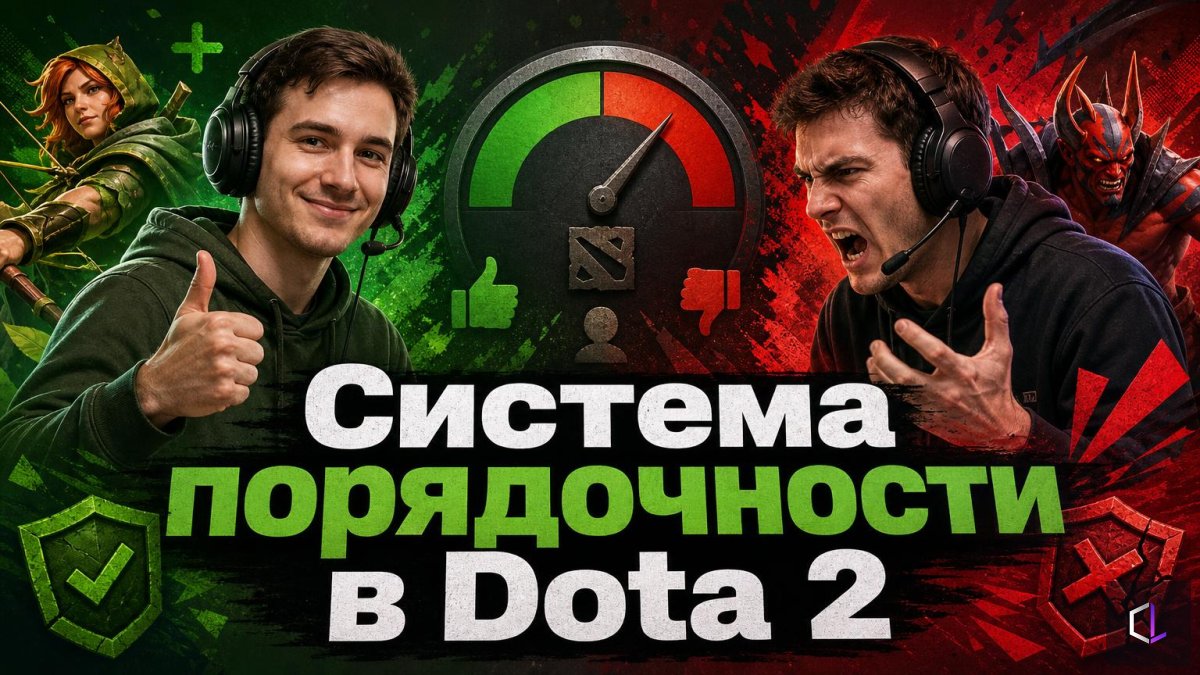
The Dota 2 player known as Durachye said that before joining professional esports, his behavior score had dropped to one. The result: a six-month ban, a second account he doesn't play on now, and a permanent one-week mute that would expire and then be reapplied after just one game. He had to change his habit of writing unnecessary things in chat because, as he put it, it didn't do him much good.
The story is a good illustration of how a system works that many people only know from an icon in their profile.
What Behavior Score Is and Why It Exists
Behavior Score is a numerical rating of an account's conduct. It isn't shaped by a single factor: it is influenced by reports from other players, commendations at the end of a match, early exits from games, and the account's overall footprint in chat. When the number falls below certain thresholds, restrictions kick in: a mute in voice and text chat, and at very low values the account is sent to a separate matchmaking queue — together with those whose rating is just as low.
The extreme end of the scale is exactly Durachye's case: a behavior score of 1 means the account is effectively cut off from regular matchmaking. Six months of ban is not a whim, but a consequence of accumulated history.
Why the Mute Returns After One Game
The most interesting part of the story is the one-week mute that "expired and then appeared again after a game." The logic is simple: the restriction is lifted by a timer, but the rating itself stays low. One game in which several people report the player is enough for the system to put them under restriction again. The timer is a pause, not a reset.
The practical conclusion: a lifted mute does not mean the problem is solved. As long as the number stays near the lower bound, one emotional match brings the punishment back. Recovery comes only through a series of clean matches, and what counts is their number, not the time that has passed.
What Actually Raises Your Rating
Working habits come down to a few points:
- Play matches to the end. Leaving early is one of the heaviest hits to your rating, even if your team is losing.
- Keep chat to game information. A rune timer, smoke, a hero missing from the lane — that's useful. Commenting on someone else's play is grounds for a report.
- Turn off text chat after the first argument. If a conversation is going in a bad direction, muting it for the match is cheaper than getting five reports.
- Commend your teammates. A commendation at the end of a game counts the same way a report does, only with the opposite sign.
- Don't respond to provocation. Durachye says outright that after the punishments he stopped talking nonsense, because it got him nothing.
What you shouldn't do is create a second account and hope your history won't follow. Durachye did exactly that, but he himself notes that he doesn't play on it now: in the end, an account's value is determined by whether it has a clean reputation, not by its age.
Why This Matters for Those Aiming at the Pro Scene
For players counting on a professional career, behavior score is not a formality. Organizations and coaches look at a candidate's conduct in public matches: a player with a history of bans is seen as a risk to team atmosphere, and at the competitive level communication makes up a large part of the work. The reputation a person builds in pubs is later read as a recommendation, or the lack of one.
The way the story is told is also telling. Durachye doesn't make excuses or glorify the past: he admits the habit harmed him, and describes the change as a practical decision. That is the approach that works — not "becoming a different person," but stopping doing what brings no results. For behavior rating in Dota 2 this is the most reliable route: every clean game adds to it, and any outburst in chat rolls back a week of effort.